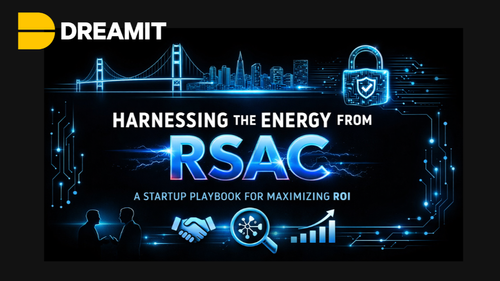
Harnessing the Energy from RSAC: A Startup Playbook to win the Week
By Mehlam Shakir, Partner, Dreamit Ventures
I’ve been coming to RSAC Conference for more than 20 years, first as a founder/CTO/operator, and now as a partner at Dreamit Ventures investing in early-stage cybersecurity startups. Along the way, I’ve worn a lot of badges, at companies small (NitroSecurity, RippleTech, Incache) and big (McAfee, RSA, Securonix).
Here’s what hasn’t changed: RSAC is where the cybersecurity world compresses into one dense week at Moscone Center, and the real ROI is usually measured in conversations, not conference content.
Recent numbers make that clear: RSAC 2024 reported 41,000+ attendees, and RSAC 2025 reported a record of nearly 44,000 attendees. And RSAC 2026 (March 23–26, 2026) is already positioned to deliver that same gravity well.
The challenge for startups: it’s incredibly easy to spend $30k–$100k+ and still walk away saying, “We were busy all week… but I’m not sure what we got.”
So let’s talk about how to harness the energy intentionally—especially if you’re a young company that needs outcomes, not vibes.
The RSAC ROI equation for startups
The highest-leverage outcomes at RSAC usually fall into a few buckets:
Pipeline creation with the right buyers (not the most badge scans)
Partner momentum (channels, SIs, cloud alliances, OEMs)
Design partner expansion (specific accounts, specific use cases)
Investor clarity (efficient fundraising conversations, sharper narrative)
Market signal (positioning, competitive intel, category temperature)
Everything you do at RSAC should map back to one of those outcomes, otherwise the week becomes expensive theater.
The booth trap (and what to do instead)
Large companies spend huge sums on booths and parties because they’re optimizing for brand gravity. Most startups are optimizing for relationship conversion.
Even “lower-cost” options like RSAC’s Early Stage Expo exist to help emerging vendors get exposure—useful, but not magical. The hard truth: a booth alone rarely delivers the meetings you actually want unless you build an outreach + scheduling engine around it.
Reframe the booth (or any presence) as a meeting hub—not a lead-gen slot machine. If you can’t reliably convert presence into scheduled conversations, the booth becomes a very expensive place to stand.
A practical playbook: how to win RSAC without overspending
1) Start with targets, not tactics
Before you buy anything, build three lists:
Top 25 “must-meet” accounts (specific people, not logos)
Top 15 partners (and the partner motion you want)
Top 10 “force multipliers” (analysts, CISOs, investors, ecosystem connectors)
Then define one sentence for each list:
“If RSAC goes well, we will leave with ____.”
If you can’t finish that sentence, your week will fill itself with randomness.
2) Run outreach like a product launch (6–8 weeks out)
The startups that win RSAC treat scheduling as a campaign:
Sequence matters: teaser → value → ask → confirm → reconfirm
Offer a concrete artifact: “15-minute POV + 2 customer examples” beats “Would love to connect”
Use tight time windows: “I have Tue 11:30 or Wed 2:10, want one?” beats “When are you free?”
Aim to land 60–70% of your meetings before you get on the plane. The remaining 30–40% will come from in-week pull, intros, and serendipity, but only if your calendar has oxygen.
3) Make your calendar a weapon
A few tactical rules that consistently outperform:
Cluster meetings by geography (Moscone-adjacent blocks)
Protect “buffer blocks” (you will run late, every day)
Anchor 2–3 “high-intent windows” per day (when you are freshest)
Avoid “lunch roulette” unless it’s a high-priority buyer/partner
You’re not trying to be busy, you’re trying to be effective.
4) Design a “meeting experience,” not a pitch
A meeting at RSAC is often noisy, rushed, and interrupted.
So build a format that survives chaos:
A 60-second problem POV
A 90-second “why now” + category shift
Two customer stories (not features)
A clear next step: pilot, partner motion, technical eval, intro, etc.
If someone leaves and can’t repeat your “why you” in one sentence, the meeting didn’t count.
5) Use side events strategically
Side events are where trust accelerates—if you attend with intent.
Pick 2–4 events max that match your target lists. Then treat them like a curated room:
Arrive with a short list of people to meet
Have a clean reason to talk (not “what do you do?”)
Follow up the next morning while the context is warm
Don’t try to “do RSAC.” Do your RSAC.
6) Share infrastructure to cut costs and increase serendipity
This is the most underused startup advantage: cooperating with peers.
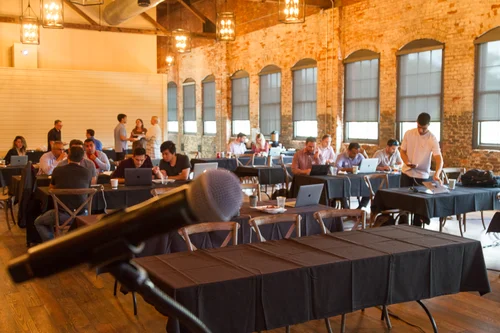
Last year, we (Dreamit) tried something simple: rent a dedicated venue steps from Moscone and have our portfolio companies bring all their meetings into one place, instead of scattering across coffee shops, hotel lobbies, and hallway fly-bys.
Two things happened:
Founders got more high-quality meeting time (less logistics tax).
Guests organically met other founders—creating “collision value” you can’t buy with a booth.
The result: founders got a full-day, invite-only meeting and expo environment for roughly $1,000 per company (because we shared costs across participants).
This year for RSAC 2026, we’re scaling that model with DataTribe and Blu Ventures, with support from Carnegie Mellon University CyLab —30 startups, a larger premium space, plus curated panels designed to pull in the right foot traffic.
That’s the core idea: don’t just buy presence, engineer outcomes.
What venture funds can do (when they’re doing it right)
A great early-stage fund can reduce RSAC randomness by providing:
Curated intros (buyers, partners, design partners, investors)
Shared physical infrastructure (meeting space, expo environments, hospitality)
Programming that attracts the right room (panels with real operators)
Scheduling support (because founders shouldn’t spend RSAC week in Google Calendar triage)
A portfolio “gravity field” (peer collisions create unexpected opportunities)
In other words: the fund can turn RSAC from “expensive chaos” into a repeatable go-to-market motion.
A simple RSAC checklist (copy/paste)
4–8 weeks before
Define RSAC outcomes (pipeline / partners / design partners / fundraising)
Build target lists + meeting ask
Launch outreach sequences + book anchor meetings
1–2 weeks before
Confirm every meeting (and reconfirm the day before)
Prep a “noisy-room” meeting format
Align the whole team on the one-sentence narrative
Onsite
Run tight calendar blocks + buffers
Do fewer events, better
Follow up next morning, every morning
Week after
Convert next steps within 7 days or the week evaporates
Closing thought
RSAC Conference is a rare concentration of energy, with tens of thousands of security leaders, founders, partners, and investors in one place. The startups that win aren’t the ones that spend the most. They’re the ones that plan, pre-schedule, and create a repeatable meeting engine.
If you’re a cybersecurity startup heading to #RSAC2026, treat this as your annual “relationship sprint.” Engineer the week so the city works for you—not the other way around.